08 June 2026

Venus–Jupiter Conjunction 2026: Understanding Right Ascension and Ecliptic Longitude Conjunctions


The Venus–Jupiter conjunction on 9 June 2026 will bring the brightest planet, Venus, and the largest planet in the Solar System, Jupiter, together in the evening twilight sky. Shortly after sunset, a glance toward the western horizon will reveal these two brilliant worlds shining side by side like diamonds. While most observers will simply enjoy the spectacle, astronomers define this conjunction in two different ways: a conjunction in Right Ascension and a conjunction in Ecliptic Longitude.

A simple example of a conjunction is the New Moon, which occurs every month and is nothing more than a conjunction of the Sun and Moon.

In astronomy, conjunctions are defined in two ways: Conjunction in Right Ascension and Conjunction in Ecliptic Longitude.

Conjunction in Right Ascension

First, let us look at a conjunction in Right Ascension (RA). For this type of conjunction, the celestial objects must have the same Right Ascension, meaning they are equally distant from the First Point of Aries when measured along the celestial equator.

For the Venus–Jupiter conjunction on 9 June, both planets have the same Right Ascension at 6:00 PM IST:

Venus: RA 07h 51m
Jupiter: RA 07h 51m

As shown in the chart, the planets align parallel to the Right Ascension lines. Another way of stating this is that they are aligned perpendicular to a declination line. This configuration is known as a conjunction in Right Ascension.


Conjunction in Ecliptic Longitude

Next, let us look at a conjunction in Ecliptic Longitude.

Ecliptic Longitude is the angle measured eastward along the ecliptic from the First Point of Aries. At first glance, this sounds similar to Right Ascension because both measurements begin at the First Point of Aries and increase eastward. However, the key difference lies in the reference plane used.

Right Ascension is measured along the celestial equator and is expressed in hours, minutes, and seconds, where 15 degrees equals 1 hour.

Ecliptic Longitude, on the other hand, is measured in degrees along the ecliptic, which is the apparent path of the Sun across the sky.

Since the ecliptic is tilted by approximately 23.44° with respect to the celestial equator, the two coordinate systems are not identical. As a result, a conjunction in Right Ascension and a conjunction in Ecliptic Longitude generally occur at different times.

In the chart below, the grid lines represent the Right Ascension and declination coordinate system, while the yellow line represents the ecliptic. Compare this with the ecliptic longitude chart, where the division lines are drawn perpendicular to the ecliptic.

Right Ascension and declination coordinate system

Ecliptic Longitude chart


By examining the orientation of these lines, we can clearly see why the conjunction in Right Ascension and the conjunction in Ecliptic Longitude occur at different times.

Let us examine both conjunctions in more detail using star charts with coordinate lines.

Conjunction in Right Ascension

Date: 9 June 2026
Time: 6:00 PM IST

Venus: RA 07h 51m
Jupiter: RA 07h 51m

The chart shows that, in the Equatorial Coordinate System, the planets are aligned parallel to the Right Ascension lines. This indicates that they are equidistant from the First Point of Aries when measured along the celestial equator.


If we now switch the same chart to the Ecliptic Coordinate System, it becomes visually obvious that the planets are not equidistant from the First Point of Aries when measured along the ecliptic.


Conjunction in Ecliptic Longitude

Date: 10 June 2026
Time: 1:30 AM IST
Venus Ecliptic Longitude      115°46'
Jupiter Ecliptic Longitude   115°46'


The chart below shows that the planets are now aligned parallel to the coordinate division lines that are perpendicular to the ecliptic. This indicates that the planets are equidistant from the First Point of Aries when measured along the ecliptic.


In other words, the planets had to move a little farther after the Right Ascension conjunction before achieving alignment in Ecliptic Longitude.

Conclusion

When you observe the Venus–Jupiter conjunction on the evening of 9 June, I hope you will remember that there is more than one way to define a conjunction. Whether it is a conjunction in Right Ascension or a conjunction in Ecliptic Longitude depends entirely on the coordinate system being used.

Understanding the difference between these two types of conjunctions provides a deeper appreciation of how astronomers measure positions in the sky and why the same celestial event can have slightly different timings depending on the coordinate system chosen.

SKY FOR THE WEEK


The concepts presented in this article were discussed during the Sky for the Week session held on 7 June 2026 at the Association of Bangalore Amateur Astronomers (ABAA). In these weekly Sunday sessions, members and visitors explore upcoming celestial events, learn how to observe them, and discuss the astronomical principles behind what we see in the sky.


From planetary conjunctions and lunar events to eclipses, meteor showers, and seasonal sky highlights, the sessions aim to connect celestial observations with the science that explains them. Understanding not only what happens in the sky, but also why it happens, helps observers develop a deeper appreciation of astronomy.

The Sky for the Week sessions are conducted every Sunday and are open to anyone interested in exploring the wonders of the night sky.


17 January 2025

COMET C/2024 G3(ATLAS) FROM BANGALORE


The most anticipated comet of the year successfully survived its close approach to the Sun on January 13th and even became a daylight comet. It was visible with small optical aids during the daytime, and many amateur astronomers managed to observe and photograph it under daylight conditions. Now, the comet is visible in the western evening skies during twilight hours.


The comet is still bright enough to be seen with the naked eye. To spot it, find a location with a clear horizon, free of obstructions like buildings or trees. This might be a bit challenging in cities like Bangalore. Just after sunset, start scanning the twilight sky for the comet. At first glance, it may appear as a dim, elongated, fuzzy object. As the sky gets darker, the comet will become more prominent. Binoculars can be helpful in spotting it, but remember to wait until the Sun has completely set below the horizon. The chart provided below will aid in locating and tracking the comet in the coming days.

The comet is currently approximately the same distance from us as the Sun—150,000,000 km—and this distance will continue to increase, causing the comet to appear dimmer. For those in Bangalore and nearby areas, the comet is well-placed in the sky; you only need a clear horizon. However, as the comet fades in the coming days and its brightness drops below magnitude 2, light pollution will become a significant factor. Try to observe it from a location with minimal light pollution.


Towards the end of the month, binoculars will be essential for spotting the comet. While it will appear slightly higher in the sky at sunset, it will also be dimmer. A dark sky and optical aids like binoculars or telescopes will greatly enhance your viewing experience at this time.

Bright comets are rare, but when they do appear, they offer a wealth of beauty and valuable insights into the formation of the solar system. Don't miss the opportunity to spot this rare visitor in the evening sky and enjoy the magnificent view.


09 January 2025

Planet Venus High in the Sky

 
On January 10, 2025, Venus will reach its Greatest Eastern Elongation. Venus, the brightest "star" in the evening western skies, outshines everything else. Just after sunset, in the evening twilight, it is easy to spot this diamond in the sky.


Greatest Elongation refers to the largest angle formed between Earth, the Sun, and a planet—in this case, Venus. On this day, Venus will appear 47 degrees away from the Sun as seen from Earth. As both Earth and Venus orbit the Sun, the angle between Venus and the Sun (as viewed from Earth) changes. When the planets align with Venus between Earth and the Sun, the angle is zero, an event known as Inferior Conjunction. Since Venus orbits closer to the Sun and moves faster than Earth, this angle increases, eventually reaching a maximum of 47 degrees. After this point, the angle begins to decrease until it reaches zero again. When Venus aligns on the far side of the Sun relative to Earth, this is called a Superior Conjunction.


At Greatest Eastern Elongation, Venus will display a nearly half-phase and will set late in the evening. As the days pass, the angle between the Sun and Venus will gradually reduce, but Venus's apparent size will increase. The phase will change from half to a crescent as the distance between Venus and Earth decreases.


At Greatest Elongation, Venus's angular size will be 24.6 arcseconds, with the planet located 101,742,566 km from Earth. As Venus continues to approach Earth, its angular size will increase to 46 arcseconds by the end of February, while its distance decreases to 53,967,713 km. Venus will be closest to Earth on March 22, 2025, at a distance of 41,977,162 km, just before reaching Inferior Conjunction on March 23, 2025.


02 January 2025

QUADRANTIDS METEOR SHOWER


The new year starts with the Quadrantids meteor shower observations. As with all meteor showers, the name comes from the constellation where the radiant resides (the region where the meteors seem to originate). The Quadrantids meteor shower originates from the constellation Quadrans Muralis, which depicts a quadrant. This constellation no longer exists in the modern adaptation of IAU constellations. The radiant association for the meteor shower was made in the early 1800s, but the parent body responsible wasn't identified until 2003.


P. Jenniskens of the SETI Institute discovered that the minor planet 2003 EH1, found by the Lowell Observatory Near-Earth-Object Search (LONEOS) telescope, was responsible for the Quadrantids meteor shower.

The minor planet 2003 EH1 is an Amor-class asteroid, a type of Near-Earth Asteroid (NEO) that orbits the Sun with a semi-major axis of more than 1 AU and does not cross Earth's orbit. 


2003 EH1 orbits the Sun every 5.52 years, with a perihelion distance of 1.2 AU and an aphelion distance of 5 AU.

The Quadrantids meteor shower peaks on January 3rd at 8:30 PM IST. The number of meteors seen can range from as low as 60 to as high as 200 ZHR (Zenithal Hourly Rate). At Bangalore's latitude, the radiant rises at 2 AM, and the location of the Quadrantids' radiant is above Beta Bootes.


The observation session for the Quadrantids can begin from 1 AM, looking north and towards the zenith away from the radiant. Scanning in and around constellations Ursa Major, Leo, and Virgo will give a good chance of spotting meteors.

Choose a place with a good view of the northern skies and zenith; a house or apartment terrace will work well. Clear skies are essential for good visibility, so check the weather forecast. There is no need for any optical aid, like binoculars or telescopes.

 An early start will help in familiarizing oneself with the skies and constellations. The low brightness of the meteors may pose a challenge, but with patience, one can spot them. To know if the meteor seen is a Quadrantid, draw an imaginary line in the opposite direction, and the line should pass through the radiant location above the Bootes constellation.

 Clear Skies and Happy Observing.


31 August 2023

URANUS RETROGRADE MOTION 2023


Uranus is in retrograde motion now, starting from 30th Aug 2023. All planets move from west to east with reference to stars, this is the direct motion. Months before reaching the opposition, we notice the daily angular motion of the outer planet, in this case, Uranus keeps reducing and at a point it appears stationary. The planet’s motion will be eastward until the stationary point.


After this we see the planet moving westward with respect to stars and the angular motion also increase but in westward direction. This movement, westward, we call it retrograde motion.

Months after Opposition, the opposition of Uranus will take place on 13th November 2023, again we observe the angular motion reducing and becoming stationary at one point, this will be Jan 28th 2024, and the planet will start moving eastward again with slowly increasing in angular motion as days passes.


Uranus will move 4 degrees west in the retrograde motion before turning east again.

Using binocular or telescope you can track the movement and measure the changes. Even with necked eye it is possible but interval of each observation should be far enough (in days) to notice the changes.

If you pick delta and rho Arietis, you can notice the movement of Uranus from delta to rho…


Happy Observing 

13 July 2022

Comet PANSTARRS closest to Earth on July 14th


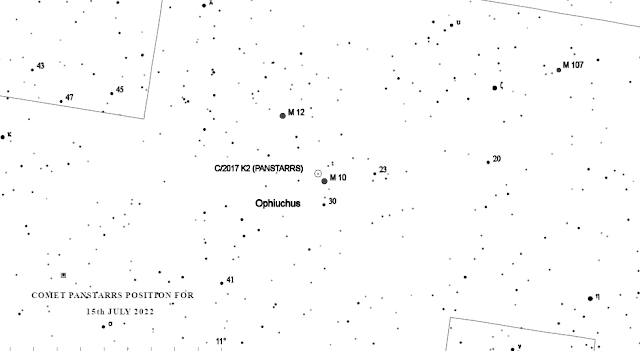
Comet PANSTARRS, C/2017 K2, will be closest to earth on 14th July 2022. The comet at its closest to earth will have a distance of 1.8AU or 269,276,167km in the constellation of Ophiuchus, this distance puts the comet beyond the planet Mars orbit.. The comet is bright enough to be seen in binoculars and small telescopes, the comet has a magnitude of 8. The comet PANSTARRS is well placed for observation, at the time of Sunset the comet will have an altitude of 45 degrees from the horizon, this gives plenty of time to observe, the comet will set at 3:45am.


Comet PANSTARRS, C/2017 K2, is easy to spot in the sky thanks to its closeness to the M10 globular cluster. The comet will be well within the field of view of binoculars, 20X80, until 18th July. Globular cluster M10 is a bright object at 6.6 magnitude, once M10 is the field it won’t be difficult to spot the fuzzy comet . The size of the comet will be roughly the size of M10. 


On 15th July the Comet PANSTARRS, C/2017 K2, will be closest to M10 with a separation of 25 arc minutes. At this small separation the comet and the globular cluster will be in the same field in the telescope, making it a wonderful sight and also to compare the brightness and size of the comet. Hope you all get a chance to view and photograph the comet. 


14 June 2022

Best Times to See Milky Way Galaxy from India


The Milky Way is one of the brightest and famous arms of our galaxy. This is in the region of Scorpius and Sagittarius constellations, this region is also the center of our galaxy. It is a magnificent view when seen under dark skies away from the city light pollution. The Milky Way will appear as a hazy band in the sky, rich with stars, with the brightest region at Sagittarius and dimmer toward north. Many people mistake it for clouds, if you get the doubt, wait for some time and the Milky Way will move along with the stars.


The band of the Milky Way extends from constellations Sagittarius, Sagitta, Cygnus, Cassiopeia to Perseus in the north. To enjoy the full Milky Way band, a place with an unobstructed view of the horizons is essential.        


The Milky Way will be in opposition in the middle of June, that means as the Sun is setting in the west, the Milky Way will be rising in the east. June and July are the best months to enjoy the Milky Way all through the night. I thought making this list of rise, meridian transit and set times of the Milky Way would be useful, so I made one.


Here are the Times for viewing the Milky Way.  


June 15: The Milky Way will rise at 7pm, it will reach meridian, highest altitude in the sky, at midnight and the Milky Way  will set at 5:30am. The Milky Way will be visible all night. 


July 15: The Milky Way will rise at 5pm, reach meridian, highest altitude in the sky at 10:30pm and the Milky Way will set at 3:45pm.


August 15: Milky way will be at meridian, highest altitude in the sky at 8:30pm and the Milky Way will set at 2am.


September 15: By the time the Sun sets, the Milky Way will be at meridian, highest altitude in the sky and it will set at midnight.


October 15: Milky Way will set at 9:30pm.


November 15: Milky Way will set at 7:30pm.


The Sun will be in Sagittarius in December so the Milky Way is not visible. 


Jan 15: The Milky Way will rise at 5am, in twilight.


Feb 15: The Milky Way will rise at 3am.


March 15: The Milky Way will rise at 1am.


April 15: The Milky Way will rise at 11pm and will reach meridian, highest altitude at 4:30am.


May15: The Milky Way will rise at 9pm and it will reach meridian, highest altitude at 2:30am.


As the best months to view the Milky Way galaxy are in the months of June and July, this will make it difficult for south India due to the arrival of Monsoon. To see the band full night or to photograph the band, it is better to move to places where the monsoon has not yet reached. 


You can use the list when going on a trek in a remote place. Check the times during the month and enjoy the view of the Milky Way.